A journal never asks you to have the right words. On a noisy day, it only needs one honest sentence. If you are looking for journal prompts for mental health, choose the question that feels manageable, write for five minutes, and stop when you have named one feeling, need, boundary, or next step.
You do not need to answer the deepest prompt on the page. Deeper is not always better. A useful entry might help you notice what changed your mood, separate a fact from a fear, ask for support, or decide that you have written enough for today.
Start Here: 10 Deep Journal Prompts for Mental Health
1. What feels most present for me right now?
Why this helps: You can begin with what is already asking for your attention instead of searching for a profound topic.
Go one step deeper: What does this feeling, thought, or situation seem to need from me?
2. What has been taking up more mental space than it deserves?
Why this helps: Naming a repeating concern can make it easier to see its actual size and place in your day.
Go one step deeper: What part of this deserves attention, and what part can I put down for now?
3. What do I need today that I have not named yet?
Why this helps: A vague mood sometimes becomes clearer when you look for the need underneath it.
Go one step deeper: What is one realistic way I could meet part of that need?
4. When did I feel most at ease this week?
Why this helps: A specific calm moment can show you which places, people, or conditions help you settle.
Go one step deeper: Which part of that moment could I make room for again?
5. What am I carrying that is not mine to solve?
Why this helps: This prompt separates care from responsibility, which can be useful when other people’s needs fill your thoughts.
Go one step deeper: What would caring without taking over look like?
6. What would make the next hour feel more manageable?
Why this helps: A one-hour window is easier to work with than the pressure to fix an entire day.
Go one step deeper: What can I remove, delay, ask for, or do first?
7. Which thought keeps returning, and what fact sits beside it?
Why this helps: Placing a repeated thought next to a plain fact can help you see where certainty ends, and interpretation begins.
Go one step deeper: What would be a more complete and accurate sentence?
8. Where am I asking too much of myself?
Why this helps: You can examine a standard without deciding that every expectation is wrong.
Go one step deeper: What would a fair version of this expectation look like today?
9. Who or what helps me feel more like myself?
Why this helps: The answer can point toward the relationships, activities, and surroundings that support you.
Go one step deeper: How could I reconnect with one of those supports this week?
10. What is one kind, honest thing I can do next?
Why this helps: Kindness and honesty together can lead to a supportive next step without ignoring reality.
Go one step deeper: When will I do it, and what might make it easier?
Choose the closest feeling and we will pick a prompt for it. This finder stays inside the article.
Private: your choices stay on this device.What would help most?
Choose a Prompt Based on What You Need
You do not need to read all 110 prompts before you begin. Use this table to find the section that fits what is happening today.
| Go to… | If you want to… | Prompt numbers |
|---|---|---|
| Emotional check-in | Name what you feel | 11-25 |
| Stress and anxiety | Sort through pressure or worry | 26-40 |
| Self-compassion | Respond to yourself more fairly | 41-55 |
| Needs and boundaries | Clarify needs and limits | 56-70 |
| Difficult days and getting unstuck | Make a hard day more manageable | 71-85 |
| Patterns and personal growth | Notice patterns and direction | 86-100 |
| Calm and daily care | Close the day more calmly | 101-110 |
110 Deep Journal Prompts for Mental Health
Start-Here Journal Prompts
Use this section when you want to begin without choosing a category. The questions cover attention, needs, ease, responsibility, expectations, support, and one practical next step, so almost any day offers an entry point.
- What feels most present for me right now?
- What has been taking up more mental space than it deserves?
- What do I need today that I have not named yet?
- When did I feel most at ease this week?
- What am I carrying that is not mine to solve?
- What would make the next hour feel more manageable?
- Which thought keeps returning, and what fact sits beside it?
- Where am I asking too much of myself?
- Who or what helps me feel more like myself?
- What is one kind, honest thing I can do next?
Journal Prompts for an Emotional Check-In
Use these prompts to describe what is present without rushing to change it. They help you name emotions, notice mood shifts, connect feelings to situations and body signals, and separate what you feel from what you think you should feel. A feeling can be information without becoming an instruction, so observation alone can serve as a useful entry point.
- What emotion is easiest to name right now?
- If my mood had a weather report, what would it say?
- When did my mood shift today, and what happened immediately before it?
- Which feeling has been harder for me to name?
- What signals has my body been giving me today?
- What am I pretending does not bother me?
- What do I wish someone understood about how I am doing?
- Which part of today felt lightest?
- What feeling needs room instead of an immediate solution?
- What am I reacting to: what happened, what I expected, or what I fear comes next?
- If this feeling could say one clear sentence, what might it say?
- What is the difference between what I feel and what I think I should feel?
- What has changed in me since this morning?
- Which emotion can I allow without acting on it right away?
- What truth might be hiding inside the words “I’m fine”?
Journal Prompts for Stress and Anxiety
Stress can make separate concerns feel like one solid wall. These prompts help you place the pieces on the page, distinguish facts from feared outcomes, and identify which demands are urgent, flexible, self-imposed, or not yours to carry. Use them when you need to reduce mental noise and choose one manageable priority.
- What is on my mind right now, without sorting or editing it?
- Which items on that list must happen today, which can wait, and which are not mine?
- What is the smallest useful step on the task I keep avoiding?
- What can I stop tracking, checking, or rehearsing for the rest of today?
- What uncertainty am I trying to solve before I have enough information?
- What outcome am I afraid of, and which facts do I have right now?
- Where do I feel rushed, even if no one has given me a deadline?
- What would “enough” look like for today?
- Which decision does not need to be made tonight?
- What could I decline, postpone, shorten, or ask for help with?
- What is adding noise to this moment, and can I remove it for ten minutes?
- What helped the last time I felt this kind of pressure?
- Which demand is real, and which one did I quietly create for myself?
- What expectation could I renegotiate?
- What is the next concrete thing I can do, and what can wait until after that?
Journal Prompts for Self-Compassion
Self-compassion does not require pretending everything is okay or excusing a mistake. These prompts help you describe your part accurately, question unfair standards, recognize quiet effort, and speak to yourself without adding unnecessary punishment. Use them when your inner critic is louder than the facts.
- What tone have I been using with myself today?
- What would I say to a friend in the same situation?
- What am I blaming myself for that was not fully in my control?
- What did I handle today that I am not giving myself credit for?
- What would “good enough” look like here?
- What kind of rest would I allow someone else in my position?
- What does my inner critic keep saying, and what evidence supports or challenges it?
- How can I describe this mistake without turning it into a description of who I am?
- What standard am I holding myself to that I would not demand from someone else?
- What effort have I made that still counts, even if the result was imperfect?
- What would I want a younger version of me to hear today?
- What strength am I using quietly right now?
- What small kindness could I give myself without needing to earn it?
- What boundary would show self-respect in this situation?
- What is a more accurate sentence than the harsh one I keep repeating?
Journal Prompts for Needs and Boundaries
A need is not a demand, and a boundary is not a punishment. These prompts help you notice where your time or energy is stretched, separate your responsibilities from someone else’s reactions, and find clear words for requests, limits, or conversations. You can write privately first and decide later what, if anything, you want to say aloud.
- Which need has been asking for my attention?
- What do I need more of, and what do I need less of?
- Where have I been saying yes while wishing I could say no?
- What conversation am I avoiding, and what makes it difficult?
- What would I like to ask for clearly?
- What support is available to me, but hard to accept?
- Whose reaction am I trying to manage for them?
- What is one boundary that would protect my time or energy this week?
- What am I responsible for in this situation, and what am I not responsible for?
- Which relationship gives me room to breathe and be honest?
- What might my resentment be pointing toward?
- Which expectation would be easier if I clarified it out loud?
- What does a safe and respectful connection look like to me?
- What do I want to keep private until I am ready?
- What do I need to understand before I decide whether to have the next conversation?
Journal Prompts for Difficult Days and Getting Unstuck
On a difficult day, insight may be too ambitious. These prompts focus on what is true, what is within reach, and what could make the next small stretch easier, such as food, water, quiet, company, rest, or one ten-minute task. Use them to create a gentler plan rather than pressure yourself into a breakthrough.
- What is one thing that is true right now?
- What is within my control in the next hour?
- What is one useful thing I can do in ten minutes?
- How could I make my surroundings a little softer or quieter?
- What can I leave unfinished tonight?
- Do I need food, water, movement, rest, company, or quiet right now?
- What am I making more complicated than it needs to be?
- Which decision could wait until I am more rested?
- What is one comfort I can accept even if it does not fix the problem?
- If I could remove one demand from today, which one would help most?
- What is steady in my life, even on a hard day?
- What helped me get through a similar day before?
- Who could I ask for one specific kind of help?
- What am I learning about my limits?
- What would a gentler plan for tomorrow include?
Journal Prompts for Patterns and Personal Growth
Growth is easier to see across several entries than inside one dramatic moment. These prompts help you compare triggers, energy shifts, habits, values, repeated feedback, and choices that feel more aligned with who you are now. Revisit your answers after a few weeks to notice changes that may be invisible day to day.
- What tends to happen before my more difficult days?
- Which activities reliably give me energy, and which ones drain it?
- When do I feel most like myself?
- What has changed in how I handle stress over the past year?
- Which old belief about myself no longer fits?
- Which value did my choices reflect this week?
- What situation keeps triggering the same response in me?
- Which recent choice felt aligned with the person I want to be?
- What feedback have I heard more than once, and what do I think about it?
- Which habit has quietly made my days easier?
- Which habit creates more friction than I admit?
- Which goal still belongs to the person I am now?
- What do I want to make more room for in this season of my life?
- What am I curious about but not ready to decide?
- What sign of progress have I been overlooking?
Journal Prompts for Calm and Daily Care
These prompts bring your attention back to ordinary details and practical care. They help you notice sensory information, small pleasures, support, sleep, preparation, and what you want to leave on the page before moving on. Use them when a larger question would add more pressure than clarity, or when you want a simple closing ritual.
- What are five details I can see, hear, or feel around me?
- What small pleasure did I notice today?
- Where can I let my body unclench a little?
- When did I receive or offer care today?
- How might last night’s sleep be influencing today?
- What can I prepare tonight to make the morning easier?
- What are three ordinary things that supported me today?
- What do I want to remember about this day?
- What can I leave on this page instead of carrying into the next hour?
- What closing sentence would I like to carry with me?
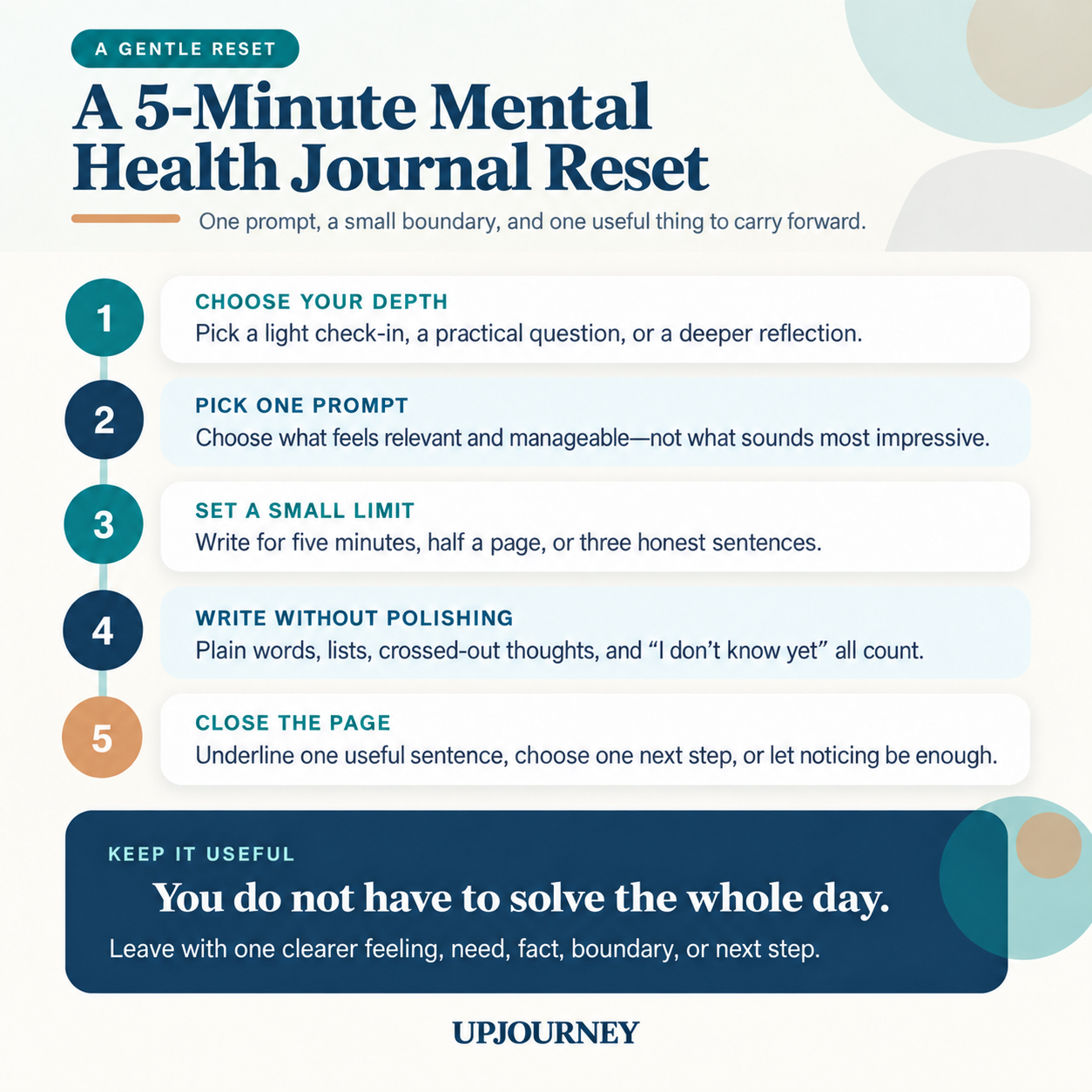
If five minutes feels like too much, answer with one line. If you want a fuller routine, see how to start journaling and choose a schedule that leaves room for missed days.
Frequently Asked Questions
What should I write in a mental health journal?
Write about one feeling, situation, need, pattern, boundary, or choice that has your attention. You can also record what happened before a mood changed or what made the day easier. A mental health journal does not need to contain your most private experiences to be useful.
How long should I journal for mental health?
Five minutes or three sentences is a practical starting point. Write longer when it feels useful, but do not use page count as a measure of honesty or progress. A short entry is easier to return to and may tell you everything you needed to notice that day.
Is it better to use a paper or digital journal?
Use the format that feels private and easy to return to. Paper can reduce screen distractions and make free-form writing simple. A digital journal may be easier to search, password-protect, and keep nearby. Your sense of privacy matters more than the format.
Can journaling replace therapy?
No. A journal can help you record thoughts, notice patterns, and prepare questions, but it cannot diagnose a problem, provide treatment, or respond like a trained professional. Use it as a personal reflection tool, not as a substitute for therapy when you want or need that kind of support.