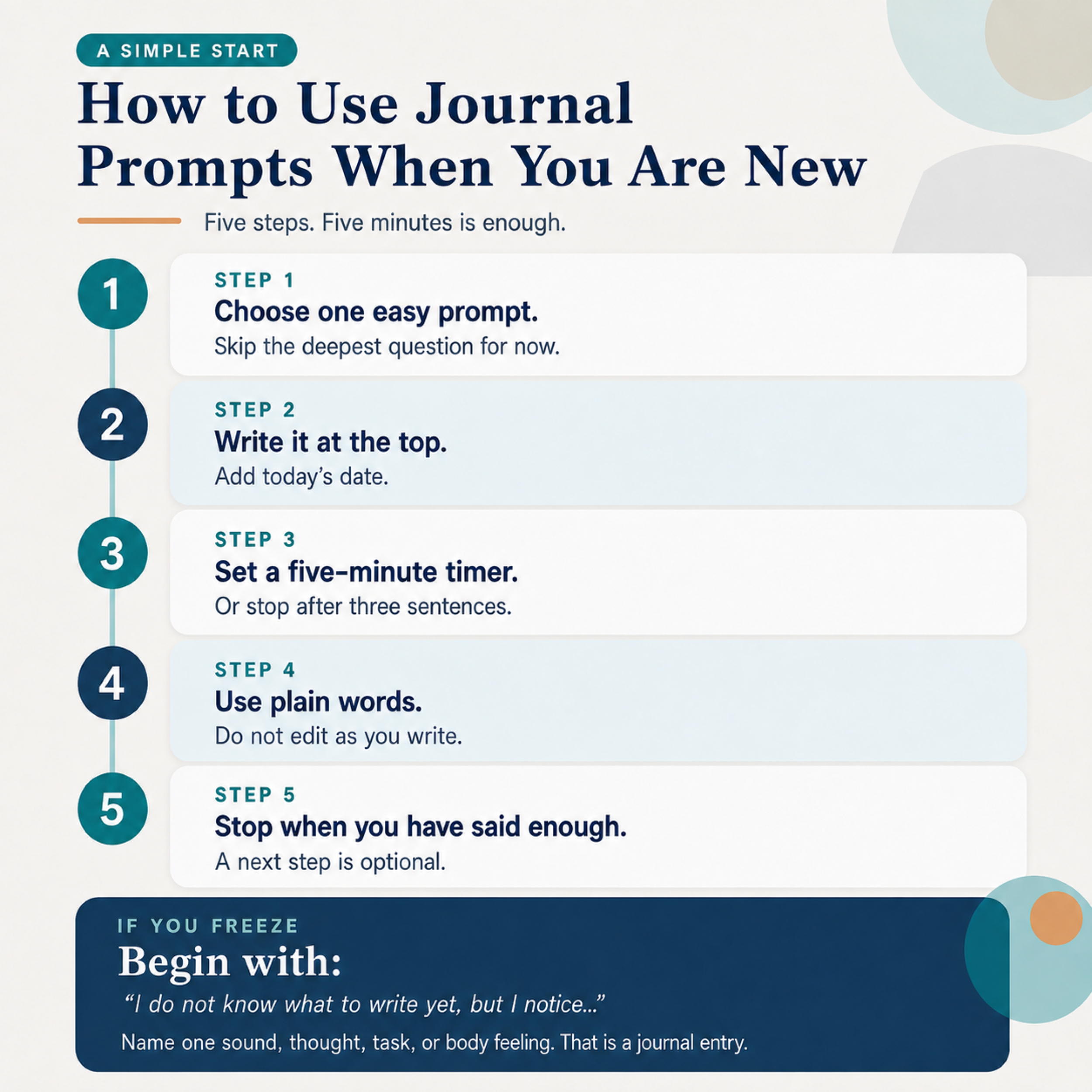
Journal prompts for beginners are simple questions that give you an easy place to start writing. Choose one prompt, set a five-minute timer, and answer in a few honest lines. You do not need perfect grammar or a daily streak. Start with what feels easy enough to answer today.
A blank page can make journaling feel harder than it is. Your first entry does not need to explain your whole life or end with a lesson. One true sentence counts. If a prompt does not fit, leave it and choose another.
What Are Journal Prompts?
A journal prompt is a focused question, phrase, or small writing task. It removes one decision from journaling: what to write about. A useful beginner prompt is narrow enough to answer now, open enough to answer in your own way, and easy to leave if it does not fit.
You can answer a prompt in one sentence, turn your answer into a list, draw it, or speak it into a private voice note. The format matters less than giving your attention somewhere to land.
Quick Start: 12 Easy Journal Prompts for Beginners
Not sure where to begin? These are prompts 1 through 12 in the full collection below. Each one includes a reason to try it and an optional follow-up. Answering the first question alone is enough.
1. What is one thing on my mind right now?
Why this helps: You do not have to summarize your whole life. You only need to name what has your attention.
Go one step deeper: What about it needs attention today, and what can wait?
2. How do I feel right now, in one or two words?
Why this helps: A short label gives your entry a clear starting point without asking for a full explanation.
Go one step deeper: Where do I notice this feeling in my body or behavior?
3. What happened today that I want to remember?
Why this helps: A small detail is easier to write about than a complete account of your day.
Go one step deeper: Why did this moment stay with me?
4. What is one small thing that made today easier?
Why this helps: This prompt helps you notice support without pretending the whole day was good.
Go one step deeper: How could I make room for that support again?
5. What do I need more of today?
Why this helps: Naming a need can turn a vague mood into information you can use.
Go one step deeper: What is the smallest available way to meet part of that need?
6. What do I need less of today?
Why this helps: Sometimes relief begins by reducing a demand rather than adding another habit.
Go one step deeper: What could I postpone, shorten, decline, or ask for help with?
7. What Is One Thing I Handled Better Than I Expected?
Why this helps: A specific piece of evidence is easier to trust than a broad statement about being capable.
Go one step deeper: What did I do that helped?
8. What Am I Looking Forward to, Even If It Is Small?
Why this helps: A meal, a message, a walk, or a quiet hour can give you a concrete point of anticipation.
Go one step deeper: What can I do to protect time for it?
9. What Is One Question I Keep Returning to?
Why this helps: You can record an open question without forcing an answer.
Go one step deeper: What part of this question can I answer today?
10. What Would “Good Enough” Look Like Today?
Why this helps: This gives you a usable standard when perfection is slowing you down.
Go one step deeper: What could I stop doing once I reach good enough?
11. What Is One True Sentence About My Life Right Now?
Why this helps: One factual sentence removes the pressure to sound wise or positive.
Go one step deeper: What feeling or need sits beside that fact?
12. What Would I Like This Journal to Hold for Me?
Why this helps: Your answer can define the journal’s purpose without locking you into one method.
Go one step deeper: What would make this journal feel private, useful, and easy to return to?
Choose the closest feeling and we will pick a prompt for it. This finder stays inside the article.
Private: your choices stay on this device.What would help most?
Choose a Journal Prompt Based on What You Need
You do not need to work through all 70 prompts in order. Use this table to find the section that matches what you want from today’s entry.
| If you want to… | Start with… | Prompt numbers |
|---|---|---|
| Get past the blank page | Easy starters | 1-12 |
| Begin the day with direction | Morning prompts | 13-20 |
| Name a mood or notice the present | Feelings and mindfulness | 21-30 |
| Notice support or treat yourself more fairly | Gratitude and self-kindness | 31-40 |
| Make a choice or take a small step | Goals and next steps | 41-50 |
| Learn about your preferences and patterns | Self-discovery | 51-60 |
| Review the day or week | Evening and weekly reflection | 61-70 |
70 Journal Prompts for Beginners
The collection is numbered continuously, so you can save a prompt number and return to it later. The prompts are grouped by purpose, but any of them can be used in the morning, at night, or whenever you have a few quiet minutes.
Easy Journal Prompts to Start Writing
- What is one thing on my mind right now?
- How do I feel right now, in one or two words?
- What happened today that I want to remember?
- What is one small thing that made today easier?
- What do I need more of today?
- What do I need less of today?
- What is one thing I handled better than I expected?
- What am I looking forward to, even if it is small?
- What is one question I keep returning to?
- What would “good enough” look like today?
- What is one true sentence about my life right now?
- What would I like this journal to hold for me?
Easy Morning Journal Prompts
Morning prompts can help you notice your starting point and decide what deserves your attention. They do not need to predict or control the whole day.
- What is one thing I am looking forward to today?
- What are the first three thoughts I remember having this morning?
- How is my energy right now, from 1 to 10?
- What would make today feel manageable?
- Which task matters most today, and why?
- What can I do before noon that my later self will appreciate?
- What boundary would protect my time or attention today?
- How do I want to speak to myself when something goes wrong today?
Journal Prompts for Feelings and Mindfulness
Use these prompts to observe what is present. You do not need to fix the feeling or find a hidden meaning.
- What feeling has been easiest to notice today?
- What feeling has been harder to name?
- What are five things I can see from where I am?
- What sounds can I hear right now?
- Where does my body feel relaxed, tense, warm, cool, heavy, or light?
- What thought has taken up the most space today?
- What happened before my mood shifted?
- What am I assuming, and what do I know for certain?
- If my mood were weather, what would it be?
- What would help me feel a little steadier right now?
Gratitude and Self-Kindness Journal Prompts
Gratitude does not require you to call a difficult day good. These prompts leave room for mixed feelings and specific comforts.
- What is one ordinary comfort I appreciated today?
- Who made something easier for me recently, and how?
- What place helps me feel at ease?
- What ability or personal quality helped me this week?
- What is working in my life, even if something else is hard?
- What effort can I give myself credit for today?
- What would I say to a friend who was in my situation?
- What mistake can I respond to more fairly?
- What is something my past self would be glad I have now?
- What is one kind choice I can make for myself today?
Goal-Setting Journal Prompts for Beginners
Good goal prompts end with a choice you can make, not a fantasy version of your life. Keep the next step small enough to schedule.
- What is one result I want by the end of this week?
- Why does that result matter to me?
- What is the smallest step I can take in ten minutes?
- What has made this goal harder to start?
- Which obstacle can I prepare for now?
- What help, information, or tool would make the next step easier?
- What can I remove from this goal without losing its purpose?
- How will I know I have done enough for today?
- What have I already done that moved this goal forward?
- What will I do next, and when will I do it?
Self-Discovery Journal Prompts
Self-discovery does not have to uncover a deep secret. It can begin with preferences, patterns, and ordinary choices.
- When do I feel most like myself?
- What topic could I talk about for an hour without getting bored?
- What part of my routine feels most natural to me?
- What drains my attention faster than I expect?
- What gives me energy without requiring a big reward?
- What opinion have I changed in the past year?
- What do I value enough to protect time for?
- What am I curious about but have not explored yet?
- Which choice from the past month felt true to me?
- What do I want more of in this season of my life?
End-of-Day and Weekly Reflection Prompts
Use these prompts to notice patterns and decide what to carry forward. You do not need to turn every difficult moment into a lesson.
- What went well today, and what helped it go well?
- What felt harder than it needed to be?
- What did I learn today about my needs or limits?
- What conversation or moment stayed with me?
- What can I leave unfinished tonight?
- What do I want to remember about this day?
- What was one small win from this week?
- What kept repeating this week?
- What would make next week feel more manageable?
- What is one thing I want to continue, change, or stop next week?
Frequently Asked Questions
What is a good first journal prompt?
A good first journal prompt is “What is one thing on my mind right now?” It is specific, works on ordinary days, and can be answered in one sentence. If that still feels too broad, name three things you can see and describe one of them.
What should a beginner write in a journal?
A beginner can write about what happened today, a feeling, a small win, a question, a choice, or something worth remembering. You can also make a list or describe what is around you. Start with a subject you already have words for.
How long should a beginner journal?
Five minutes or three sentences is a useful starting point. A short limit makes it easier to begin and easier to return. Write longer when you want to, but do not treat page count as proof that an entry was worthwhile.
Is it better to journal on paper or digitally?
Paper and digital journals both work. Paper may help if you want fewer notifications and like writing by hand. A notes app may suit you if speed, search, and easy access matter more. Choose the format you can keep private and return to with the least friction.
Can journaling replace therapy?
No. A journal can help you record and organize thoughts, but it cannot diagnose a problem, offer treatment, or respond to you like a trained professional. Use journaling as a personal writing tool, not as a substitute for therapy when you want or need that kind of support.