Journaling tends to feel most difficult in the minute before you begin. Make that minute smaller. Choose a format you can use with reasonable privacy, set a timer for two to five minutes, and write one honest sentence about what is happening, what matters, or what you need next.
A list counts. A sketch counts. A voice note counts too. Now you have your first journal entry.
What Is Journaling?
Journaling is the intentional act of recording something for yourself. That might be what happened, how you feel, a problem you are sorting out, an idea, a plan, a sketch, or one detail you want to remember.
It does not have to look like a diary entry. You can use full sentences, fragments, bullet points, drawings, photos, or a voice recording. You can write every morning, once a week, after an important event, or only when you have a reason.
A journal is a tool, not a test. Your entry does not need to be wise, neat, positive, or complete. It only needs to serve a purpose for you.
How to Start Journaling in Five Simple Steps
1. Give Today’s Entry One Job
Journaling gets harder when you expect one entry to explain your whole life. Choose one practical purpose instead:
- Remember: Record a moment, conversation, event, or ordinary detail you do not want to lose.
- Sort: Put a crowded thought or feeling into clearer words.
- Decide: Compare options or name what matters most.
- Plan: Choose the next step and move practical details out of your head.
- Create: Collect ideas, observations, lines, images, questions, or sketches.
- Check in: Notice your mood, energy, needs, or attention without trying to fix everything.
Your reason can change from entry to entry. You do not have to choose a permanent journaling identity before you begin.
If you are unsure, choose the least dramatic job that would help today. A busy mind may need a list. A difficult decision may need one clear question. A good day may deserve one detail you want to keep.
2. Protect Your Privacy Before You Write Deeply
Decide where the entry will live and who could reach it. Privacy affects how freely you can write, and it is easier to plan for it before the page contains something sensitive.
For a paper journal, choose a storage place. For a digital journal, review your device lock, shared accounts, cloud syncing, backups, notifications, and deletion settings. Avoid writing sensitive material on a work or school device.
You can also lower the level of detail.
Example:

A conversation left me unsettled. I need more time before I respond.
That can be a complete entry. You do not owe the page names, secrets, or a full history. Initials, broad labels, temporary notes, and entries you delete after writing are all options.
3. Choose a Format You Will Actually Use
The best journal is the one you can reach, use, and store with reasonable privacy. You do not need to buy anything before your first entry.
| Format | It may suit you if… | Check first |
|---|---|---|
| Paper notebook | You enjoy handwriting or want fewer notifications | Storage, portability, hand comfort, and privacy |
| Notes app or document | You type quickly or want search and easy access | Shared logins, syncing, backups, and lock-screen previews |
| Voice note | Speaking feels easier than writing or typing | Who can overhear and where recordings or transcripts are stored |
| List, sketch, or photo | Paragraphs feel unnatural or tiring | Whether the image or detail reveals private information |
Try a format rather than debating it for too long. If it creates friction, switch. Changing methods is not starting over.
4. Use the Five-Minute Journaling Method
Five minutes is long enough to complete an entry and short enough to repeat. It is a starting point, not a rule.
Minute 1: Arrive
Write the date. Notice where you are and what is competing for your attention.
Start with: Right now, I notice…
Example:

Right now, I notice that I keep checking the time and my shoulders feel tight.
Minutes 2 and 3: Name One Thing
Choose one subject. Do not summarize your entire day.
Ask one question:
- What happened?
- What is taking up the most mental space?
- What do I want to remember?
- What am I trying to decide?
- What feels unfinished?
Example:

Tomorrow’s meeting is taking up the most space. I know what I want to ask, but I am worried I will rush through it.
Minute 4: Ask What Would Help
Move toward a need, choice, or boundary if that feels useful.
What would make this slightly easier or clearer?
Example:

I can put my first question at the top of my notes and ask it before I start explaining.
Sometimes there is no next step. You may need more information, support from someone else, or time away from the subject. Noticing that is enough.
Minute 5: Close
Finish this sentence: After I close this journal, I will…
Example:

After I close this journal, I will prepare the document I need and then stop working.
When the timer ends, stop. Continue only if writing feels steady and useful, not because the entry seems too short.
5. End the Session on Purpose
You do not have to reread the whole entry or turn it into a lesson.
Ask: Do I need to act, wait, ask for help, or leave this alone?
Then choose one response:
- Act: Write the smallest next step.
- Wait: Note when you may return to the issue.
- Ask: Name the person or kind of support you need.
- Leave it: Close the journal without solving the subject.
Return your attention to the room. Notice the time. Move your body, drink water, or begin the next ordinary task.
Choose the closest feeling and we will pick a prompt for it. This finder stays inside the article.
Private: your choices stay on this device.What would help most?
What to Write in a Journal When You Are New
If a blank page makes you freeze up, use a simple structure. These five methods are complete practices, not warm-ups you have to expand.
1. Write One True Sentence
Ask: What is the easiest true thing to say about this moment?
Your sentence can be ordinary. One true sentence is more useful than a polished paragraph you do not mean.
Example:

I do not want to make this decision tonight.
2. Use Notice, Name, Choose
Write one line for each:
- Notice: What is happening inside or around me?
- Name: What seems most important?
- Choose: What is one reasonable next step?
Example:

I notice that I am rereading the same message. I name that I am not ready to answer. I choose to reply tomorrow afternoon.
3. Record Five Plain Facts
Write five things that happened without explaining what they mean.
Example:

Woke at 7. Missed the early bus. Arrived ten minutes late. The meeting went ahead without a problem. Bought bread on the way home.
This works when you want a record, when you feel emotionally full, or when you keep getting pulled into analysis.
4. Make Three Small Lists
List:
- What is taking up space?
- What can wait?
- What do you want to do next?
Fragments count. Spelling does not matter. You are clearing a work surface, not writing a final draft.
5. Answer One Prompt
Choose the question that best fits today. Skip any prompt that feels intrusive, irrelevant, or too heavy.
- What do I want to remember about today?
- What would make the next hour easier?
- What am I assuming, and what do I know?
- What deserves my attention, and what can wait?
- What am I looking forward to, if anything?
- What am I avoiding because the first step is unclear?
- What would “enough” look like today?
Prompts are invitations. You do not have to answer one just because it is on the page.
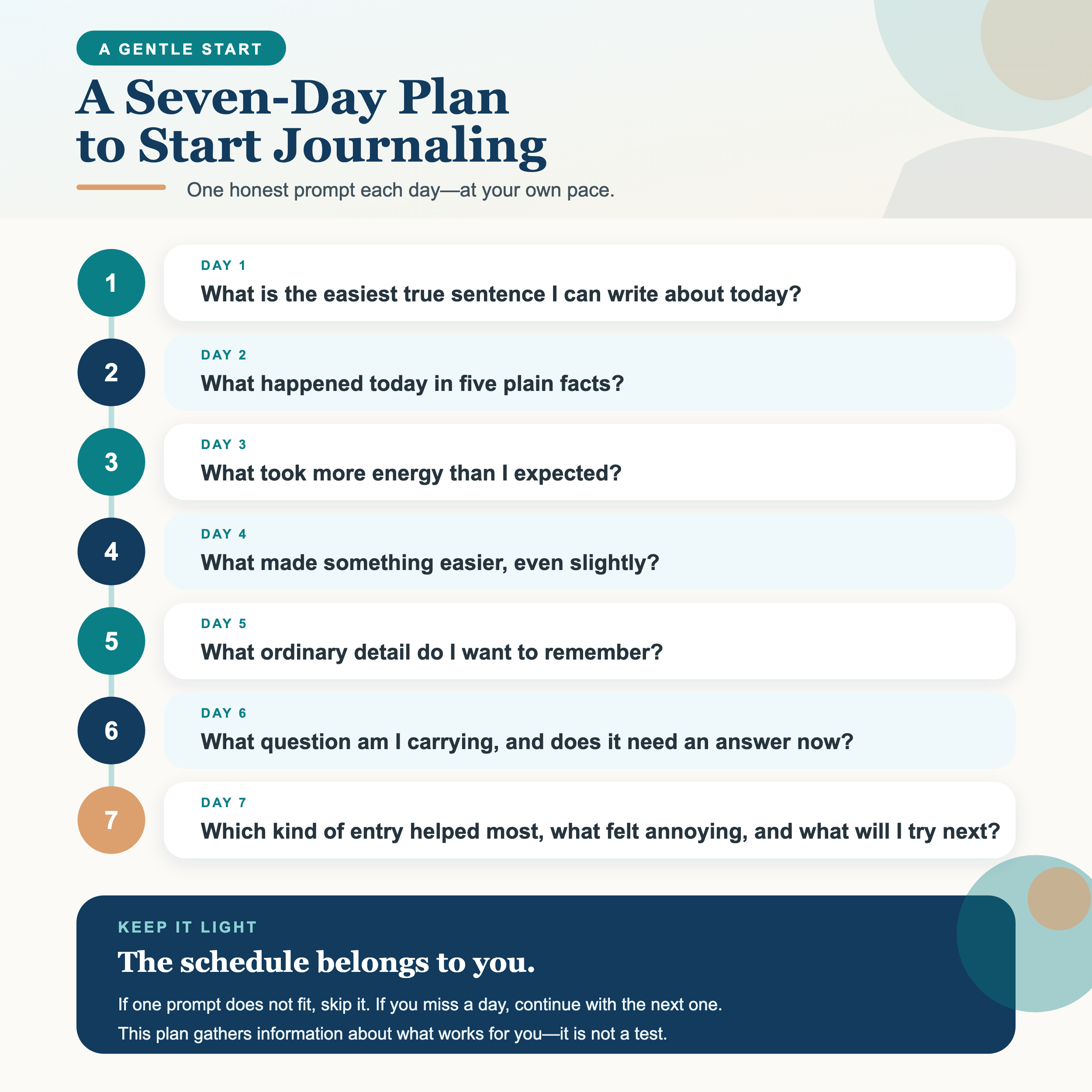
How to Make Journaling a Habit Without Creating Pressure
Do not begin with “I will journal every day forever.” Build a short experiment instead.
A realistic plan sounds like this: “After I make my morning drink, I will sit at the kitchen table and write for five minutes. If the morning is rushed, I will write one sentence on my phone after lunch.”
Make the plan fit your real life:
- If mornings are hurried, do not choose mornings just because they sound disciplined.
- If writing before bed keeps your mind active, move the session earlier.
- If your schedule changes often, use an event as the cue instead of a clock time.
- If daily writing feels like homework, try twice a week or write when you have a clear reason.
Missing a day does not create a debt. Start with the day you are in. You do not need to catch up on your journal.
After two weeks, ask which entries helped, which method felt easiest, whether the timing fit, and what you want to keep, change, or stop.
Why Do I Struggle to Journal?
Most beginner problems are signs that the practice asks too much of you or gives you too little direction. Change the design before blaming your discipline.
“My Mind Goes Blank”
Describe the blank:
Example:

I do not know what to write. I can hear traffic. I am thinking about dinner. I feel distracted.
There, you’ve already started. Continue only if another thought appears.
“My Writing Sounds Awkward”
That is fine. A private entry is working language, not a finished essay. Use fragments, abbreviations, crossed-out words, or bullets. Write so the entry helps you, not so it impresses an imaginary reader.
“Nothing Important Happened”
Record one small detail: a sentence you heard, a choice you made, a change in the weather, what felt easier than expected, or something you ate, read, watched, or noticed.
A journal can preserve ordinary life. It does not need a plot.
“I Keep Writing About the Same Problem”
More explanation is not always more insight. Change the question:
- Is there new information?
- Is there an action I can take?
- Is there a conversation I need to have?
- Do I need support?
- Would leaving this alone for now be healthier?
If the entry keeps you circling, close it and do something that returns you to the day.
“I Keep Forgetting”
Make the journal easier to notice and use. Put a paper journal and pen near your cue, move the app to your home screen, or use a short reminder. Keep the minimum small enough that you can complete it on an ordinary day.
“I Missed Several Days”
Start with today. Do not backfill unless you want the record. Blank pages are not evidence that you failed.
“I Am Worried Someone Will Read It”
Take the concern seriously. Change the storage, device, level of detail, or format before writing anything sensitive. If reasonable privacy cannot be maintained, keep the entry practical and general.
Should You Journal Every Day?
No. You can journal daily, a few times a week, after specific events, or whenever a clear need appears. Choose a rhythm that supports the journal’s purpose without turning the practice into another obligation.
Daily writing may help if you want a detailed record or enjoy the routine. Weekly writing may give you more to reflect on and better fit your schedule. Event-based journaling works when you use the page to prepare, decide, remember, or close something specific.
Length matters less than usefulness. Start with two to five minutes. Stop sooner if one sentence does the job.
When Journaling Feels Worse Instead of Better
Journaling can become unhelpful when it turns into repeated rumination, harsh self-judgment, pressure to disclose painful details, or a substitute for action or support you need.
If your distress rises while you write, stop. Put the journal away. Look around and name five things you can see. Take one slow breath, then choose a neutral physical action such as drinking water, washing your hands, or changing rooms.
If you try again, shorten the session, stay with plain facts, or choose a lighter subject. You can also decide that journaling does not help you. It is optional.
You never have to write about trauma, reveal a secret, forgive someone, revisit a painful memory, or continue with a prompt that feels too intense.
Important note: Journaling is not therapy, medical care, or crisis support. If difficult thoughts or feelings keep interfering with daily life, consider speaking with a qualified mental health professional. If you may hurt yourself or someone else, stop writing and contact local emergency services or a crisis service in your area now.
Frequently Asked Questions
What should a beginner write in a journal?
Start with what is easiest to name: what happened, what you notice, what is taking up mental space, or what you want to do next. One sentence, list, sketch, or voice note can be a complete entry.
How do I start my first journal entry?
Write the date and finish the sentence, “Right now, I notice…” Add one thing that matters and one next step, if there is one. Stop after five minutes.
How long should I journal?
Two to five minutes is enough for a beginner. Longer is not automatically better. Stop when you have said enough, when the timer ends, or when writing no longer feels useful.
Is paper or digital journaling better?
Neither is better for everyone. Paper can reduce digital distractions. Digital entries can be faster, searchable, and easier to access. Choose based on privacy, comfort, accessibility, and which format you are likely to use.
Can journaling replace therapy?
No. A journal can help you record experiences, prepare questions, or organize what you want to discuss. It cannot diagnose a condition, provide treatment, monitor risk, or respond to an emergency.