A journal can catch a thought before it disappears, hold a worry that has been pacing in circles, and give an unfinished idea somewhere to wait. The page does not need you to be organized first. It gives you room to become more organized as you write.
You can use a journal to untangle a busy day, make sense of a difficult conversation, or hold on to a detail you do not want to lose. It does not require a perfect routine. Some days may call for a full page; others may need only a sentence.
If you are curious about what journaling can actually do, the ten benefits below are a good place to start.
10 Benefits of Journaling
1. It gives busy thoughts somewhere to go
Thoughts often arrive as a tangle. A task reminds you of a worry, the worry brings up a conversation, and the conversation makes tomorrow feel crowded before it has even started. Writing gives each thought a place to land instead of asking you to hold everything at once.
Once the thoughts are visible, you can sort them. One item may need action today. Another may depend on information you do not have yet. A third may be uncomfortable but outside your control. That separation can make a busy mind feel more workable, even when nothing has been solved.
Use the journal as a temporary holding place. Make a quick list, circle what matters now, and leave the rest on the page. If the same thought keeps circling, ask: “What do I know, what am I assuming, and what is one next step?”
2. It helps you name feelings more precisely
A vague mood can follow you for hours because it has no clear name. “I feel bad” tells you that something is wrong, but it does not tell you whether you are disappointed, embarrassed, lonely, irritated, worried, or tired.
Journaling slows the moment down long enough to choose a more accurate word. You can write, “I feel disappointed because I expected a clearer answer,” and then notice what lies beneath it. Perhaps you need clarification. Perhaps you need time. Perhaps you need to admit that the outcome matters more to you than you wanted it to.
Precision does not make a feeling disappear. It makes the feeling easier to respond to. When you can name what you feel, you are better placed to ask for support, set a boundary, take a break, or let the emotion pass without turning it into a verdict about your whole day.
3. It can reveal patterns and triggers
A single entry is a snapshot. Several entries can show what keeps repeating, especially when the pattern is too gradual to notice from inside an ordinary week.
You may see that a certain task leaves you tense before you begin, that your concentration drops on days when you skip lunch, or that one kind of conversation keeps draining you. You may also notice what helps: a quieter morning, a clear deadline, an honest check-in, or enough time to prepare.
Reviewing past entries can make those connections easier to see. Look for repeated situations, feelings, needs, and responses. Do not force a theory from two difficult days. Treat a pattern as useful information, not a diagnosis or a fixed rule about who you are.
For guided reflection, try these journal prompts for self-discovery.
4. It helps you work through difficult emotions
A difficult emotion can feel larger when every part of it arrives at once. The event, your interpretation, the physical reaction, and the fear about what happens next can blend into one heavy experience. Journaling gives you enough space to separate those pieces.
Start with what happened in plain language. Then write what you felt, what you thought the moment meant, and what you may need now. You do not have to uncover a hidden lesson or retell every detail. The aim is to understand your present experience well enough to care for it.
Some entries end with a next step. Others end with, “I am still upset, and I understand why.” Both can be useful. If writing becomes repetitive or leaves you more overwhelmed, stop for the day. The journal is there to support you, not demand that you push through every feeling.
5. It creates a pause before you respond
A private entry lets you write the first version of something without sending it. That version may be sharp, defensive, confused, or much longer than the conversation needs. It can stay on the page while you decide what is worth carrying forward.
After a disagreement, write four short lines: what happened, what you assumed, what you felt, and what you want the other person to understand. You may find that your first reaction is valid but not yet ready to become a message. You may also find a simple request buried underneath a page of frustration.
The journal does not need to become a script. Its job may be to help you find the calmer, clearer version of what you mean. That pause can protect a relationship, prevent a rushed reply, or show you that no response is needed yet.
6. It helps clarify choices
A decision feels harder when facts, fears, preferences, and other people’s expectations are all mixed together. Journaling gives the choice a shape. Instead of asking, “What should I do?” for the tenth time, you can ask smaller questions that produce useful answers.
Write the options at the top of the page. Under each one, note what you know, what you are assuming, what matters most to you, and what information is missing. You can also write what each choice would require during the next week, rather than trying to predict the next five years.
Journaling cannot remove uncertainty, but it can show you where the uncertainty lives. You may discover that you need to ask one question, test a smaller version, wait for better information, or choose based on a priority you already know.
7. It makes goals and progress visible
A goal stays abstract when it exists only as something you want “someday.” A journal can bring it closer by recording the next step, the obstacle most likely to slow you down, and the sign that tells you progress is happening.
Keep the entries close to action. Record what you did, what got in the way, and what you will try next. This creates a more honest record than memory alone, which often forgets quiet progress and overemphasizes the week when nothing went to plan.
Looking back can also show that the goal needs to change. You may need a smaller target, a different timeline, or permission to let the goal go. The journal tracks your direction without turning the original plan into a promise you must keep forever. For more structure, use these journal prompts for goals.
8. It helps you notice positive experiences
Good moments are often quieter than difficult ones. A kind reply, ten calm minutes, a meal you enjoyed, or the relief of finishing a task may disappear from memory while the frustrating part of the day keeps replaying.
Journaling helps you give those moments a little more attention. Instead of forcing a long gratitude list, choose one specific experience and describe why it mattered. “Coffee was good” becomes more personal when you add that you drank it slowly by an open window before anyone needed anything from you.
This is not an instruction to make a hard day sound positive. A balanced entry can hold disappointment and appreciation on the same page. The point is to notice more of what happened, not to edit out what hurt. These gratitude journal prompts can help when the page feels blank.
9. It supports learning and problem-solving
Finishing an experience does not automatically turn it into a lesson. A busy day can end with a vague sense that something worked or failed, while the useful details disappear as soon as the next task begins.
A short reflection helps you keep what the experience taught you. After a class, project, meeting, or unfamiliar task, write what worked, what surprised you, where you got stuck, and what you would change next time. The answer can be practical: ask for the deadline earlier, prepare one example, or leave more room for questions.
The same freedom supports problem-solving. A journal gives half-formed ideas somewhere to develop before they have to be sensible or polished. You can sketch connections, list unlikely options, and follow a thought far enough to see whether it has anything useful in it.
10. It keeps a record of ideas and experience
Memory keeps the outline and drops many of the details. A journal can preserve the exact phrase that made you laugh, the small habit your child had that month, the first idea behind a later project, or the ordinary routine that eventually changed.
You do not need to document every day for the record to matter. A date and a few concrete details are enough. Write what the room looked like, what someone said, what surprised you, or what you hope you will remember when the moment is no longer recent.
This benefit does not require emotional writing. A sketch, travel note, reading list, voice memo, or record of a funny conversation still counts. Over time, those small entries become evidence of what held your attention and how your life looked from where you were standing.
Choose the closest feeling and we will pick a prompt for it.
Private: your choices stay on this device.What would help most?
How to Start Journaling in Five Minutes
Start by choosing one job for the next five minutes. The table gives you a clear format and an opening line, so you do not have to invent a whole journaling routine before you begin.
| Your Goal | What to Write? |
|---|---|
| Clear your head | Make a quick list. Put each worry, task, or question on a separate line. |
| Understand a feeling | Describe what happened in one sentence. Then name the feeling and what you may need. |
| Make a decision | Divide the page into “What I know” and “What I still need to know.” |
| Move a goal forward | Note what moved, what got in the way, and the smallest useful action you can take next. |
| End the day with balance | Record one difficult moment and one good or steady moment. Do not make either one cancel the other. |
Set a five-minute timer. Stop when it rings, even if the entry is unfinished. If continuing feels useful, make that a choice rather than a rule. Spelling, neatness, and complete sentences do not matter.
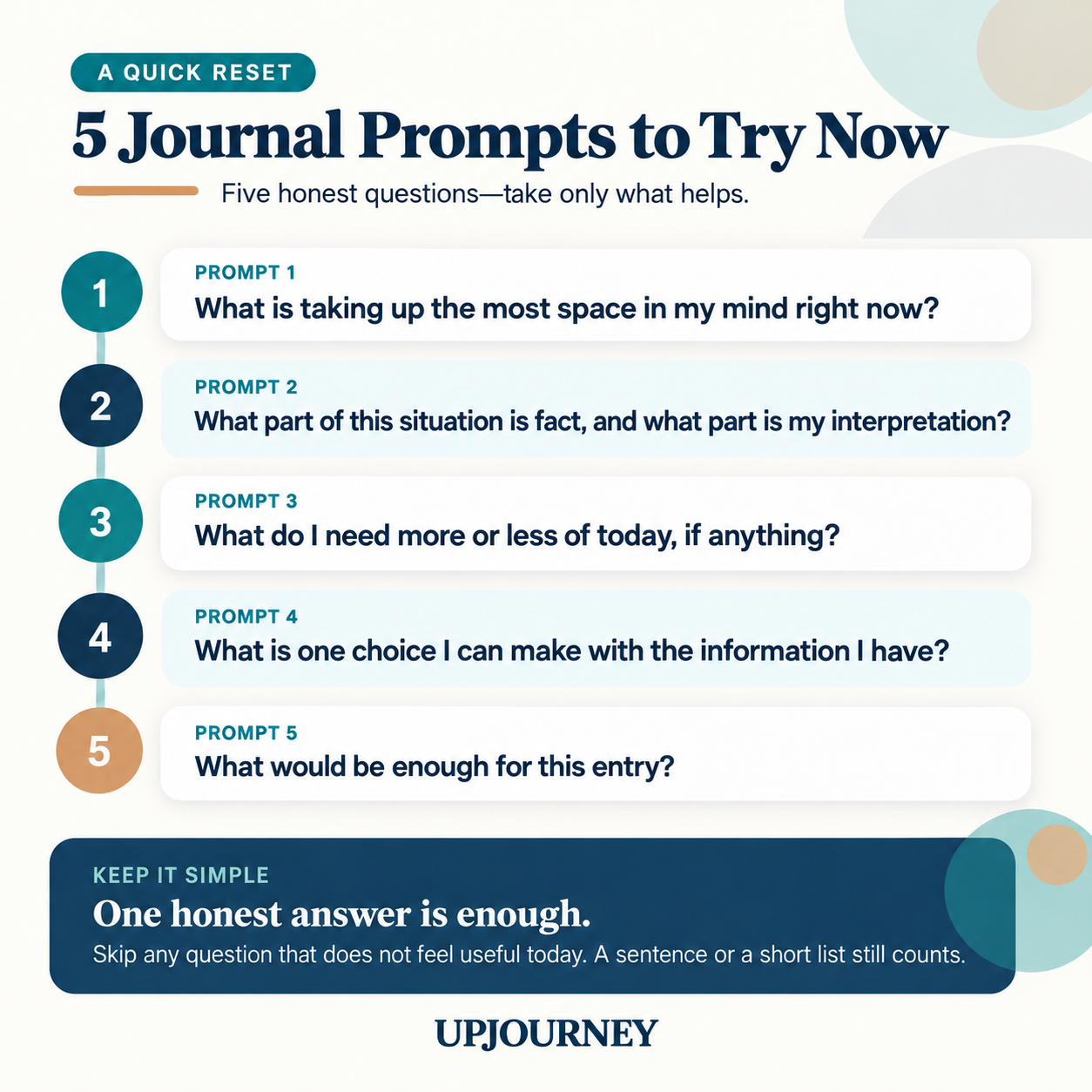
If you want more help getting past the blank page, start with these journal prompts for beginners.
Frequently Asked Questions
Does journaling help with anxiety or depression?
Journaling may help with anxiety or depressive symptoms when a suitable method gives thoughts structure, supports positive reflection, or leads to a useful next step. Some trials report benefits, but journaling is not a treatment by itself. If writing increases distress or rumination, stop and choose another form of support.
What should I write in my first journal entry?
Write the date and answer one question: “What feels most present for me today?” You can respond with a sentence, a list, or a sketch. A first entry does not need to explain your life, set goals, or sound meaningful.
How long should I journal?
Start with five minutes for ordinary personal journaling. Stop when you have said enough or when the entry starts repeating itself.
Is it better to journal on paper or digitally?
Paper and digital journals can both work. Paper removes notifications and makes drawing easy. A phone or computer is searchable, portable, and often faster. Choose the format you can access, protect, and return to without adding pressure.