A blank journal can feel very different depending on when you open it. In the morning, the day is still unwritten, with plans, worries, and possibilities competing for your attention. By evening, you have conversations to replay, moments to remember, and thoughts you may not want to carry into tomorrow.
That difference is what makes the timing worth considering.
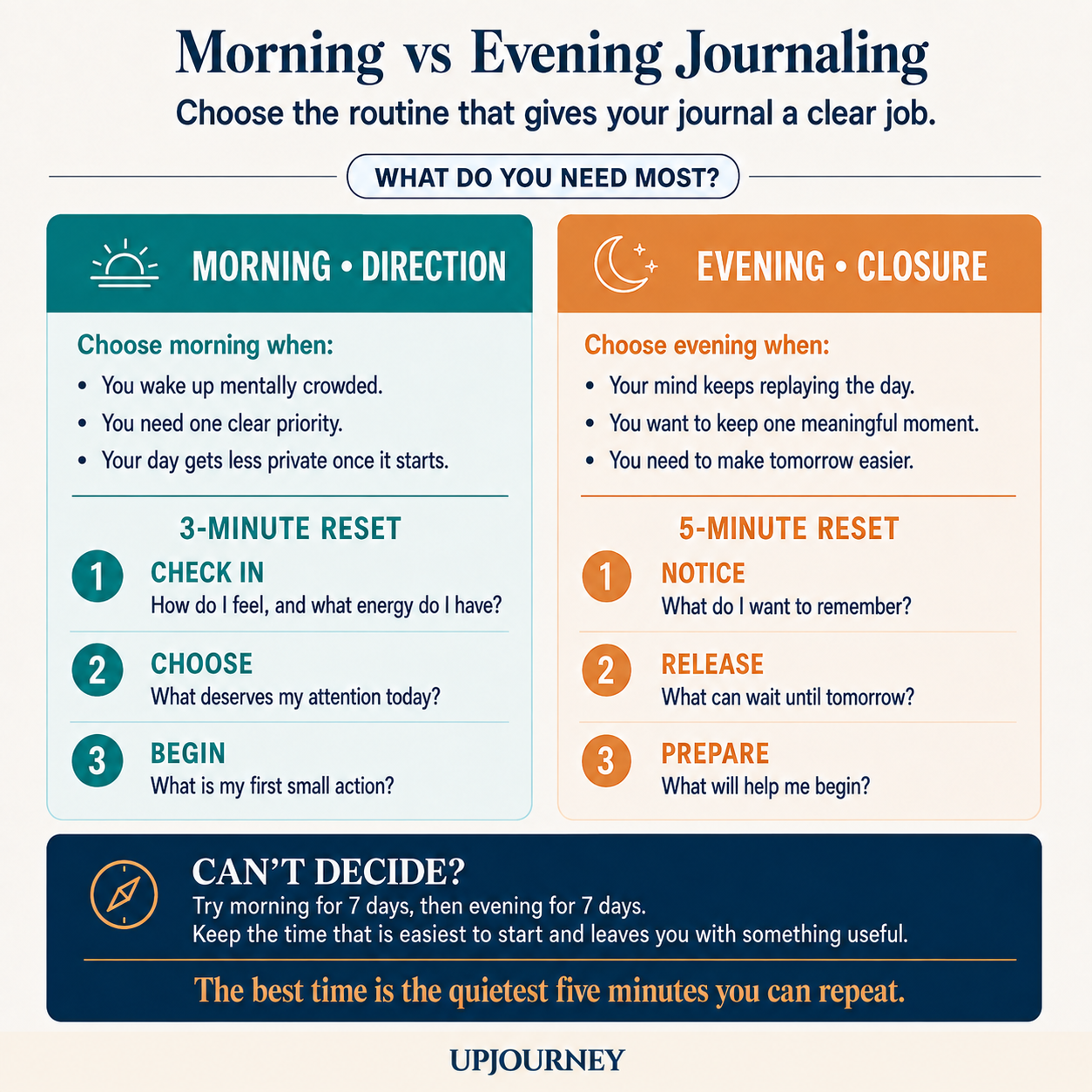
Morning journaling can help you check in with yourself, choose a priority, and prepare for what is ahead. Evening journaling can help you reflect on what happened, preserve a meaningful detail, or put unfinished thoughts down for the night. Some people prefer one, while others use both for different reasons.
Let’s look at what morning and evening journaling each does best so you can decide which one fits your needs, energy, and lifestyle.
Is It Better to Journal in the Morning or at Night?
Neither time is better for everyone. Morning journaling may suit you when your mind feels crowded after waking, you want to decide what deserves attention, or the day becomes less private once it starts. Evening journaling may suit you when you want a clear stopping point, need somewhere to keep unfinished thoughts, or have more quiet at night.
Choose morning journaling if you often ask, “How do I want to approach today?” Choose evening journaling if your question is, “What do I want to keep, change, or leave here?”
Your schedule matters more than an ideal routine. A parent with a rushed morning may write after dinner. A night-shift worker may journal after waking in the afternoon. The useful time is the one that gives you enough privacy to be honest and enough ease to return.
Tip:

Try one time for seven days. Keep the test small: five minutes, one prompt, and no requirement to write well. At the end of the week, ask whether the timing made it easy to start and whether the entries gave you anything useful. If not, move the session.
What to Write in a Morning Journal
A morning journal is a place to notice your current state and choose how to meet the next few hours. Pick one of these five prompts. You can stop after the first clear answer.
- How do I feel right now, and what may have influenced it?
This gives you a plain check-in before plans and other people’s needs take over. You can name low energy, anticipation, irritation, calm, or uncertainty without trying to correct it.
Go one step deeper: What would help me work with this feeling today? - What matters most today?
A long task list treats every item as equally loud. This question asks you to make a choice. Your answer can be a task, a conversation, rest, or a boundary.
Go one step deeper: What is the first visible action I can take? - What do I need more of or less of today?
This turns a vague mood into a need you can consider. You might need more time, food, movement, quiet, information, or help. You might need less rushing, screen time, noise, or self-criticism.
Go one step deeper: What small choice would respect that need? - What might make today harder, and how can I respond with care?
You can prepare for a likely snag without rehearsing every bad outcome. Keep the answer practical and within your control.
Go one step deeper: If the difficult moment arrives, what will I do first? - What am I looking forward to today, if anything?
This is more specific than asking yourself to feel positive. It lets you notice a small point of interest, comfort, or relief. “Nothing yet” is also an honest answer.
Go one step deeper: Is there a small pleasure I can make room for?
Morning writing does not have to become a planning session. If a prompt gives you a useful sentence, close the notebook. Writing more deeply is not automatically more useful.
Choose the closest feeling and we will pick a prompt for it. This finder stays inside the article.
Private: your choices stay on this device.What would help most?
What to Write in an Evening Journal
An evening journal is a place to notice what the day held and decide what deserves another look. It should help you close the day, not put it on trial.
- What felt most important about today?
A day contains more detail than you need to record. This question lets one moment, decision, feeling, or interaction rise above the rest.
Go one step deeper: What made that matter to me? - What went well, even if the day was hard?
You can recognize something that worked without pretending the whole day was good. A completed task, a kept boundary, or a quiet minute counts.
Go one step deeper: What helped that happen? - What felt difficult, and what do I need now?
This moves the entry away from replaying the problem and toward the present. The answer may be sleep, space, support, food, a conversation, or no further writing tonight.
Go one step deeper: Can this need wait, or does it need a small response now? - What am I still carrying that can wait until tomorrow?
Unfinished tasks and stray worries can feel as if they must stay active so you will not forget them. Put each item somewhere you can find it again.
Go one step deeper: Where will I record the next action? - What is one kind, realistic first step for tomorrow?
A modest first step can give tomorrow a starting point without turning bedtime into another work session.
Go one step deeper: What can I prepare tonight in under two minutes?
You do not have to find a lesson in every day. Sometimes the useful entry is, “That was tiring, and I am done writing about it for now.”
More Morning and Evening Journal Prompts
Use these when you want variety. Choose one prompt rather than treating the list as an assignment. Skip any question that does not fit your day.
Morning Journal Prompts
- What thought was waiting for me when I woke up, and does it need my attention?
- How is my energy this morning, and what choice would respect it?
- What would help me feel on track by noon?
- What can wait a day without a real cost?
- Which task would create the most relief if I began it?
- What boundary would make today easier to manage?
- Which message or conversation needs a clear first sentence from me?
- What am I assuming about today, and what do I know?
- What small pleasure would I like to notice before the day ends?
- If plans change, what smaller version of today’s priority would still count?
Evening Journal Prompts
- Which moment from today do I want to remember, and what detail makes it vivid?
- What took more energy than I expected?
- What gave me some energy or ease?
- What choice did I handle fairly today?
- What did I notice about the way I work, rest, or connect with others?
- What is unfinished, and where will I keep it until I can return?
- Which boundary helped today, or which one may need attention tomorrow?
- Is there a repair I want to start, and what is the smallest respectful step?
- What does not need a solution tonight?
- What would I like my future self to know about this ordinary day?
Should You Journal Twice a Day?
You can journal twice a day, but each session should have a separate purpose. Let the morning entry point forward and the evening entry look back. Two short entries are enough. If the second session feels like an obligation, keep the one that does more for you.
Missed days do not create a debt. Start with the day you are in. You do not need to catch up on your journal.
How to Make the Timing Easier to Keep
A journaling routine is easier to repeat when the cue and the materials are obvious. Choose one existing part of your morning or evening, then place the journal where the two actions can meet.
- Keep the notebook beside your coffee supplies, charger, or bedside lamp.
- Choose the prompt before the session so you do not spend your writing time searching for one.
- Use bullets when complete sentences feel like extra work.
- Set a short timer and let yourself stop when it rings.
- Move the session when your schedule changes, rather than treating the routine as broken.
When the blank page is the problem, choose one of these journal prompts for beginners. For formats beyond questions, browse these journaling ideas. If consistency is harder than choosing a time, use this guide to decide how often to journal.
Paper and digital journals can both work. Paper removes notifications and may feel more private when the notebook is stored securely. A phone or computer may be easier when you already have it with you. Choose the format that removes the most friction from the time you pick.
Frequently Asked Questions
Is It Better to Journal in the Morning or at Night?
Journal in the morning when you want to check in and choose how to approach the day. Journal at night when you want to review what happened and decide what can wait. If both sound useful, test each time for a week and keep the easier one.
What Should I Write in My First Morning Journal Entry?
Write how you feel, what matters most today, and the first small action you can take. One sentence for each is enough. Your first entry does not need a life story, a perfect plan, or an explanation of why you started.
How Long Should a Morning or Evening Journal Entry Be?
Start with two to five minutes. A useful entry might be one sentence, three bullets, or a page of free writing. Stop when you have noticed something, named a need, made a choice, or recorded the detail you wanted to keep.
Is It Better to Journal on Paper or Digitally?
Use paper if you want fewer screen distractions and enjoy writing by hand. Use a digital journal if speed, search, portability, or password protection make it easier to return. The better format is the one you can use privately at the time you choose.