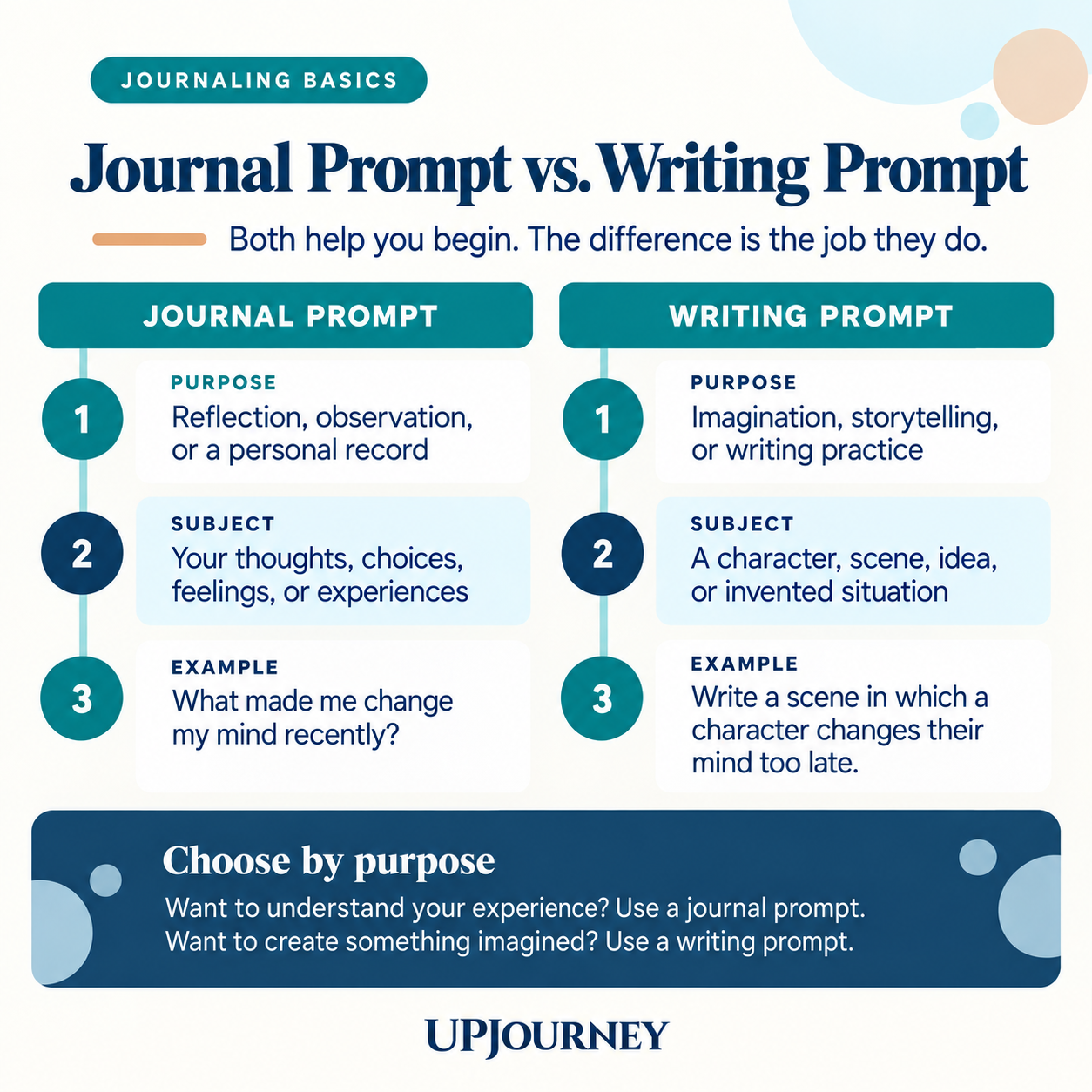
A journal prompt is a short question, phrase, or writing cue that gives your entry a clear starting point. Instead of asking you to write about your whole day, it points to one idea: what is on your mind, what you want to remember, or what needs your attention.
You can respond with one sentence, several pages, a sketch, or a few disconnected thoughts. You may also change the wording, answer only one part, or skip a prompt that does not fit. A journal prompt is simply a tool for focusing your attention so that beginning feels more manageable and the entry has somewhere useful to go.
What Are Journal Prompts For?
A journal prompt makes starting easier by removing one decision: what to write about. It can also narrow a busy train of thought, help you notice a detail you might have missed, or add variety to a routine.
- When the page is blank, a prompt supplies the first subject.
- When your thoughts feel scattered, a prompt gives the entry one focus.
- When your entries feel repetitive, a prompt offers another angle.
You do not have to use prompts every time you journal. Free writing may suit a day when you already know what you want to say. But when the blank page feels bigger than the thought in your head, a good question makes starting feel more doable.
If you are curious about what the practice may offer beyond an easier start, see the benefits of journaling.
What Can a Journal Prompt Look Like?
Journal prompts usually take one of three simple forms. None is better than the others. Choose the form that makes a response come to mind.
- A question: “What do I want to remember about today?”
- A sentence starter: “Right now, I keep thinking about…”
- A small writing direction: “Describe one choice you are considering.”
A good prompt is clear enough to answer in one sitting but open enough to leave room for your own experience. “Write about your life” is broad. “What changed my mind this week?” gives you an edge to begin from.
Choose the closest feeling and we will pick a prompt for it.
Private: your choices stay on this device.What would help most?
5 Journal Prompt Examples
1. What is taking up most of my attention today?
This daily reflection prompt helps you identify the thought, responsibility, person, or situation that receives the most of your mental attention. Instead of trying to summarize everything that happened, you begin with the subject that keeps returning to you.
Once you name it, consider why it feels important. Does it require preparation, action, reassurance, or simply acknowledgment? If you want to continue, separate the part that needs your attention now from anything that can reasonably wait.
Example:

Thursday's presentation keeps returning to my mind. I know the material, but I have not practiced the opening. I can do that once before dinner.
2. What made today a little easier?
This gratitude prompt helps you notice a specific source of support without asking you to describe the entire day as good. Your answer might involve another person, a useful routine, a thoughtful decision, a convenient tool, or one quiet moment that reduced the pressure you were feeling.
Describe what happened and the difference it made. Focusing on the effect keeps the entry concrete and may reveal forms of support you can appreciate, ask for, or create again.
Example:

My coworker sent the notes before I had to ask. It saved me half an hour and made the afternoon feel less rushed.
3. When do I feel most like myself?
This self-discovery prompt invites you to look for real situations in which you feel comfortable, natural, or unguarded. Rather than trying to define your entire personality, think about where you are, what you are doing, who is with you, and what you do not feel pressured to hide or perform.
Look for details that repeat across different memories. They may point toward the activities, relationships, environments, and values that help you feel most at ease with yourself.
Example:

I feel most like myself during slow conversations with one close friend. I do not have to perform or hurry to fill every silence.
4. What do I know about this choice, and what am I still guessing?
This decision-making prompt separates confirmed information from predictions, fears, and assumptions. Begin by writing down what you know from direct experience or reliable information. Then identify what you suspect, expect, or worry might happen but have not yet verified.
The prompt will not make the decision for you. However, it can reveal which concerns are supported by facts, which need to be questioned, and what information you may need before making a choice.
Example:

I know the new role pays more and requires two office days. I am guessing that the team will expect late replies. I can ask about working hours before I decide.
5. What is one small action that would make tomorrow easier?
This next-step prompt turns reflection into one manageable action. You do not need to solve everything that could make tomorrow difficult. Instead, look for one small source of friction you can remove in advance.
Choose something specific enough to complete in a few minutes, such as preparing an item, sending a message, writing a reminder, or making one simple decision. The goal is to end the entry with a realistic step that makes the next day slightly easier to begin.
Example:

I can put the form and my ID beside the front door tonight. That removes one thing to remember in the morning.
How to Use a Journal Prompt
- Choose one prompt. Pick a question that feels relevant or easy to answer. The deepest-looking prompt is not automatically the best one.
- Write a plain response. Give yourself five minutes or three sentences. Start with the first detail that comes to mind and leave editing for later.
- Stop when you have said enough. You may underline one sentence, add a next step, or close the journal. Every entry does not need a conclusion.
For a larger starting set, try these journal prompts for beginners.
What If a Journal Prompt Does Not Fit?
Skip it. A journal prompt is an invitation, so you do not owe it an answer. You can also make the question smaller, change its wording, or write about why it does not fit.
If every prompt feels like homework, try free writing for a few minutes or record one factual sentence about the day. Prompts should reduce the friction of beginning. When they add friction, set them aside.
Frequently Asked Questions
What should I write in response to a journal prompt?
Write the first specific answer that feels true enough to put on the page. It can be a sentence, a list, a memory, a question, a sketch, or a description. You do not need to cover every part of the prompt or turn the entry into a lesson.
How long should a prompted journal entry be?
A prompted journal entry can be one sentence or several pages. Five minutes or three sentences is a practical starting limit. Length does not determine whether the entry is useful.
Is it better to answer journal prompts on paper or digitally?
Paper and digital journals both work. Choose the format that is private, available, and comfortable for you. Paper reduces screen time; a phone or computer may be easier to search, edit, or use wherever you are.
Can journal prompts replace therapy?
No. Journal prompts can help you record experiences and reflect in your own time, but they do not provide the trained, responsive support of therapy. Journaling and therapy can serve different purposes.