The main types of journaling include daily, reflective, prompted, gratitude, expressive, stream-of-consciousness, morning pages, mindfulness, mood, bullet, goal, habit, learning, one-line-a-day, dream, travel, reading, commonplace, and creative journaling. The best type is the one that matches what you need from the page and is simple enough to use again.
These labels overlap. A bullet journal can include a mood tracker. A travel journal can use daily reflection. A digital journal can hold any method on this list. Treat the names as useful starting points, not rules you have to follow.
Journaling is a tool, not a test. One honest sentence still counts, and you can change methods when your reason for writing changes.
19 Types of Journaling, Explained
1. Daily Journaling
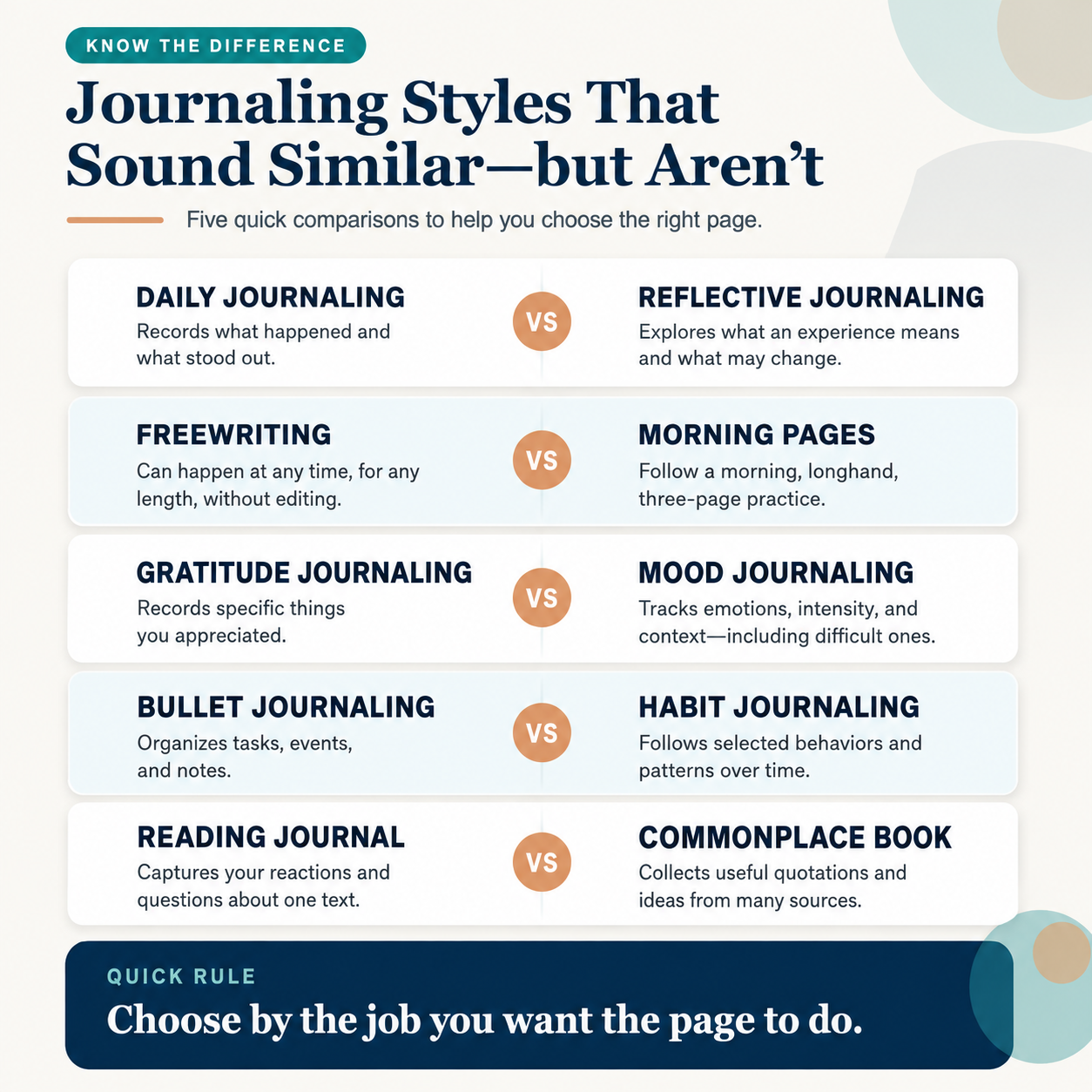
Daily journaling records what happened, what stood out, or how the day felt. It can read like a diary, but it does not have to cover the whole day. One scene, conversation, or observation is enough.
This method suits anyone who wants a personal record without a fixed framework. Add the date and write what you would want to remember six months from now. If you need a starting cue, try these everyday journal prompts.
2. Reflective Journaling
Reflective journaling looks back at an experience to understand your response, choices, or learning. A daily journal may record that a meeting went badly. A reflective entry asks what made it difficult, what you noticed about yourself, and what you might do next.
Use it after a decision, a project, a conversation, or a change. A simple structure is: What happened? What did I notice? What do I want to remember or change? These self-discovery journal prompts offer more angles for reflection.
3. Prompted Journaling
Prompted journaling begins with a question, a sentence starter, or a brief writing prompt. The prompt removes the first decision and gives the entry one subject. You can answer it in a sentence, a list, or several pages.
This is a practical choice when a blank page makes you stall or when your entries keep circling the same subject. Start with one clear question, such as “What do I need more of this week?” For more options, use these journal prompts for beginners.
4. Stream-of-Consciousness Journaling
Stream-of-consciousness journaling, also called freewriting, means writing whatever comes to mind without arranging it first. You do not stop to polish sentences or make the entry coherent. The point is to follow the thought as it moves.
Try it when you already have something to say, but keep editing yourself before the words reach the page. Set a short timer, begin with “Right now…,” and keep the pen or cursor moving until time is up.
5. Morning Pages
Morning pages are a specific form of stream-of-consciousness writing associated with Julia Cameron’s The Artist’s Way. The original practice calls for three longhand pages written first thing in the morning.
Unlike general freewriting, morning pages have a specific time of day, a handwritten format, and a page target. They may fit people who want a roomy morning practice. If three pages make you avoid the notebook, freewriting for five minutes is a different method and may suit your life better.
6. Expressive Writing
Expressive writing explores your thoughts and feelings about a stressful, emotional, or personally important experience. In the research tradition associated with psychologist James W. Pennebaker, it is usually a timed exercise repeated across several sessions rather than an open-ended diary habit.
This method is more focused than venting. It may include what happened, how it affected you, and how your understanding changes as you write. It also asks more from the writer than a light daily entry, so it does not need to be your default form of journaling.
7. Gratitude Journaling
Gratitude journaling records specific things you appreciate. It does not require you to call the whole day good or ignore what was difficult. A useful entry names one moment, person, object, or source of support and explains why it mattered.
Instead of repeating a quick list, add one detail: “The bus arrived as I reached the stop, which gave me ten quiet minutes before the appointment.” Specificity keeps the practice connected to your actual day.
8. Mindfulness Journaling
Mindfulness journaling records what you notice in the present moment. The subject may be your breathing, physical sensations, surroundings, thoughts, or emotions. You describe what is here before deciding what it means.
A sensory check-in is an easy start: write one thing you can see, hear, feel, smell, and taste. If the five senses feel too mechanical, describe one ordinary object slowly and precisely.
9. Mood Journaling
Mood journaling tracks emotions and their context over time. An entry may include the feeling, intensity, energy level, situation, and anything else you want to compare later. The record matters more than finding an explanation every day.
Keep the scale simple enough to use. For example: “Tense, 6 out of 10. Low energy after lunch. Felt steadier after the walk.” Review several entries before treating a repeated detail as a pattern.
10. Bullet Journaling
Bullet journaling is a flexible organization method created by Ryder Carroll. Its core practice uses concise entries and symbols to capture tasks, events, and notes. The official Bullet Journal guide calls this rapid logging.
The decorated spreads often seen online are optional. A plain notebook, an index, dated logs, and a few consistent symbols are enough. Choose this method when you want planning and brief reflection in one place rather than long prose entries.
11. Goal Journaling
Goal journaling turns a desired result into plans, progress notes, questions, and adjustments. It can help you record why a goal matters, what you tried, what got in the way, and what comes next.
A useful entry stays close to action: “I completed the outline. The next step is to draft the opening before Friday.” It is also worth noting that a goal no longer fits. For guided entries, try these journal prompts for goals.
12. Habit Journaling
Habit journaling records whether a behavior happened and, when useful, what made it easier or harder. A tracker shows frequency. A journal entry adds context.
Track only a few details you expect to use. A row of missed boxes is information, not a verdict. You might write, “Read for ten minutes after breakfast. Leaving the book on the table helped.”
13. Learning Journaling
A learning journal captures what you understood, what remains unclear, and how you might apply an idea. It works for classes, work projects, skill practice, or any subject you are trying to understand over time.
After a lesson or project, answer three questions: What did I learn? What surprised me? What will I try differently? This turns notes into a record of your thinking, not only a collection of facts.
14. One-Line-a-Day Journaling
One-line-a-day journaling keeps each entry deliberately short. You might record the day’s main event, strongest feeling, funniest sentence, or one detail you do not want to lose.
This method fits busy periods and anyone who resists long entries. It also makes old entries quick to review. The line can be plain: “Took the longer walk home and saw the first yellow leaves near the library.”
15. Dream Journaling
A dream journal records dreams soon after waking, before the details fade. Entries may include the setting, people, events, emotions, images, and fragments you remember. Interpretation is optional.
Keep the journal within reach and write the clearest detail first. If you remember only one image or feeling, record that. A fragment is still a complete dream-journal entry.
16. Travel Journaling
Travel journaling preserves places, routes, meals, conversations, surprises, and practical details from a trip. It can be a factual log, a reflective journal, a sketchbook, or a mix of all three.
Record details, photographs may not hold: the sound outside the station, the wrong turn that became useful, or what something cost. A few notes written during the day are often easier than reconstructing everything at night.
17. Reading Journaling
A reading journal follows your experience of a book, article, poem, or other text. You can record reactions, questions, favorite passages, predictions, and connections to your own life or other readings.
It differs from a reading log, which may list only titles, dates, and ratings. Begin with the title and one sentence: “The idea I keep returning to is…”
18. Commonplace Journaling
A commonplace book collects material you want to keep from outside sources, such as quotations, facts, ideas, recipes, observations, or lines from conversations. The focus is curation rather than a chronological account of your life.
Add the source so you can find it again, then note why the item earned a place. That final sentence turns a copied passage into something connected to your own thinking.
19. Creative Journaling
Creative journaling uses drawing, collage, color, lettering, poetry, found paper, or other forms alongside or instead of prose. An art journal usually emphasizes visual expression, while a junk journal often includes reused or collected materials. Both fit under the broader creative-journaling label.
You do not need to make a finished artwork. Tape in a ticket, add two colors that fit the day, sketch an object nearby, or arrange a page around one word.
Choose the closest feeling and we will pick a prompt for it. This finder stays inside the article.
Private: your choices stay on this device.What would help most?
How to Choose a Journaling Method in 4 Steps
- Name the focus. Decide whether you want to remember, understand, notice, plan, track, collect, or create. Pick one main focus for now.
- Choose your amount of structure. Use prompts or trackers if direction helps. Try freewriting or creative journaling if a fixed format makes you feel boxed in.
- Set an honest size. A one-line entry used four times may tell you more than a three-page plan you keep postponing. Choose a limit that fits an ordinary day.
- Run a seven-day experiment. Use one method for a week, then ask what made you want to return and what created friction. Keep, change, or drop it based on that evidence.
You do not need to choose the most serious-looking method. Choose the one that gives you a usable page.
Can You Combine Different Types of Journaling?
Yes. Many methods combine naturally because they do different jobs. You might use a bullet journal for tasks, add one mood line to the daily log, and write a longer reflective entry only when you have something to examine.
Start with one main method. Add another only when you can name the gap it fills. A second notebook is optional; separate sections, tags, headings, or page colors can keep several methods clear in one place.
Paper, Digital, or Voice: Does the Format Matter?
Paper, digital, and voice are formats, not separate purposes. You can keep a gratitude journal in a notebook, a mood journal in an app, or a reflective journal as private voice notes.
| Format | Useful When… | Tradeoff |
|---|---|---|
| Paper | You want a tactile, screen-free space that can hold writing, sketches, and loose materials. | Harder to search, copy, or protect if the notebook is found. |
| Digital | You type faster, want search and tags, or need your journal on several devices. | Notifications and other apps can interrupt the session. |
| Voice | Speaking feels easier than writing or you want to capture tone while walking or traveling. | Recordings take longer to review and may need stronger privacy controls. |
The best format is private enough for what you want to record and easy enough to reach when you want it. Neat handwriting, special supplies, and daily entries are optional.
Frequently Asked Questions
Which type of journaling is best for beginners?
Prompted journaling and one-line-a-day journaling are easy starting choices because they limit the decisions and the amount of writing. Begin with “What is on my mind right now?” or record one detail from the day. After a week, keep the structure if it helps or try a more open method.
What are the 7 different types of journaling?
There is no official list of seven. Seven common types are daily, reflective, prompted, gratitude, stream-of-consciousness, bullet, and creative journaling. Other valid lists may include mood, dream, goal, reading, travel, or expressive writing because journaling methods can be grouped by purpose in different ways.
What are the four main types of journals?
A practical four-part grouping is reflective journals, planning journals, tracking journals, and creative or collection journals. Reflective journals explore experience. Planning journals organize action. Tracking journals record changes over time. Creative and collection journals preserve images, ideas, memories, or source material.
What are 6 types of journals I should have?
You do not need six journals. If six purposes genuinely help you, a balanced set could include daily, reflective, gratitude, goal, reading, and creative journals. They can also be six sections within a single notebook or app. Keep only the ones you use.
What is the 3-3-3 journaling method?
The 3-3-3 journaling method is an informal template, so its categories vary. One common version asks you to write three things you are grateful for, three things you want to accomplish, and three affirmations or encouraging statements. You can change the categories, but label your version so the numbers remain useful rather than confusing.